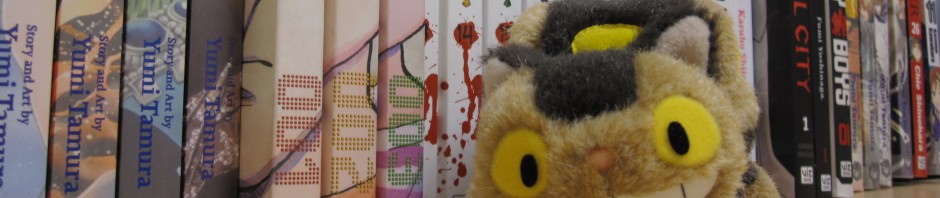
Why not be gender-neutral? Publishers and gender-genres

There’s a phrase I’ve been hearing a lot in the manga industry that actually bothers me quite a bit.

It goes: Girls will read stuff for guys, but guys won’t read stuff for girls.

There’s actually a fair amount of financial proof that not a lot of guys read stuff written for girls and girls read stuff originally written for a male audience, but I don’t have direct access to that kind of information and that’s not my point.

My point is that there’s some stuff that is “meant for girls” that could have a much wider appeal if marketed properly, so why don’t comic book  publishing companies take that route?

I’ll explain further: Sure, there are plenty of comics (especially manga) that are clearly of no interest to most guys. A lot of shojo and josei manga are really just about light-fluffy romance and girls obsessing over stuff that most guys wouldn’t want to understand, let alone enjoy reading about. That said, there’s plenty of really awesome titles that are billed as shojo or josei, but could almost be gender-neutral.

Example one: Basara by Yumi Tamura, published by Viz under their shojo line.

Basara by Yumi Tamura

Basara by Yumi Tamura

I’m up to volume 12 of the series and while it’s got a female protangonist and one of the major plot points is a romance between two of the main characters, the story is about a people’s rebellion under a brutral post-apocalyptic tyranny. While there is the romance, overcoming the big problem comes first, which is more of a shounen trope. Sure, the art does lean towards a shojo style, but other works by Yumi Tamura, like Chicago, remind me more of Naoki Urasawa than Arina Tanemura. (Ha, wow, comparing Arina Tanemura and Yumi Tamura is like comparing Danielle Steel to Stephen King!)

Why didn’t Viz bother to publish under a more universal line if Basara had the potential to sell well with girls AND boys?

To be honest, Shogakukan billed Basara as shojo, serialized it in Betsucomi (a shojo manga magazine) and Viz probably just rode that wave. If I was a Viz editor or someone else involved in that decision-making process, I would have shoved it into their signature line because Basara has that potential to sell well to both genders. After all, it was pretty well-received by critics when it was released. Since I decided to pick it up, I haven’t heard a fan, male or female, say a bad thing about it either. But while some fans are less discerning about their picks, most male fans are just going to see the shojo logo on the spine of the books and turn the other direction.

It’s probably very easy to point the finger at Japanese publishers sticking to their slightly more sexist, but more accepted societal norms, but that does not mean U.S. publishers have to blindly follow them.

Karakuri Odette by Julietta Suzuki

Karakuri Odette by Julietta Suzuki

Going from Basara to something more recent, a Tokyopop release by Julietta Suzuki called Karakuri Odette, which I copy-edited as an intern for them. While it’s more likely to be categorized as shojo for many reasons, Karakuri Odette also doesn’t focus on typical shojo plots. Tokyopop even labeled it as a comedy series and it was billed as an a-typical shojo by critics. Yet, the cover design is hot pink and accented with hearts. Not to stereotype, but most male manga fans aren’t going to pick that up at a bookstore unless they’re shopping for their girlfriend’s Christmas gift. If the cover had been mostly green, which is an accent color on Tokyopop’s cover design, it would have faired much better with dudes just picking it up and seeing if it was anything they wanted to read.

I’m no expert at marketing (although I find it and advertising to be really fun, I almost wish I’d gone into PR instead of journalism,) but I feel like such niche targeting is detrimental to some series. I know when I was younger, I wouldn’t have touched shounen or seinen series because I totally thought they were all like Naruto, which I dislike, and not very good. Still, I was curious and if someone had put something out there without making it look like it was shojo or shounen, I would have probably gone for it and tried to read more series like it.  I probably would have been more willing to pick up something different than pure shojo fluff.

I’m not saying the industry has to change how they categorize everything, I’m just saying that we could make SOME series gender-neutral where it fits and start lifting the stereotypes of shojo being JUST for girls and vice-versa.

Baka-Updates Manga’s genre site -This site goes into how they define each genre, which includes shojo, shounen, etc as well as regular genres.

Why Can’t Female Leads Be Happy Without A Boyfriend? -An article about the difference between comics and manga as well as shojo and shounen.

Posted in manga | Tagged , , , , , , , , , , , | 3 Comments

The Manga Cliche Review: Musical Talent, Part 3

So last time I talked about La Corda d’Oro, which is the kind of much too cliched shojo manga I wish people had the foresight not to publish in Japan, let alone the U.S. Media tie-ins make a lot of money for publishers so I can see why someone did.

Still, I respect classical music a lot and I feel that manga about it must have a certain kind of intensity to it. There’s just something about the way classical music is written that, to me, feels like there is serious passion in it at all times. It’s like tasting the blood, sweat and tears of the composer. The composer worked damn hard to make that music sound like springtime for you.

That’s where my next pick comes in. It shows you that world and just how much work goes into the creation of classical music. The blood, the sweat, the tears, etc.

The Classic (al Music): Nodame Cantabile by  Tomoko Ninomiya

Nodame Cantabile

So full of passion, you can see the awesome.

Nodame is about two students at Momogaoka College of Music, Megumi Noda (Nodame herself) and Shinichi Chiaki. Both are excellent pianists, but they couldn’t be more different. Chiaki is the school’s top student, extremely well-organized and successful and Nodame is messy, lazy and extremely disorganized. Chiaki strives to perfect his music and Nodame likes to literally play it by ear.

The story starts out with Chiaki having a rough time attempting to switch majors from piano to conducting. Not only are his advisors trying to stop him, but he has a serious fear of flying, which makes it extremely tough for him to take on a new career. On top of that, he’s trying to get out of a relationship and the creepy Nodame is kind of stalking him. Chiaki winds up getting stuck helping out Nodame in class and caring for her on occasion, which begins their funny little relationship.

What I really love is about Nodame Cantabile is that it feels just like being around my school friends, particularly my anime club. Everyone has different specialties, different goals, different personalities, but we can band together around one thing and work to make it great. In my club’s case, it’s being a great anime community. In the case of Nodame, Chiaki and their friends, it’s making music.

Not to overgeneralize, but Nodame Cantabile is manga as it should be. It’s carefully paced and finely crafted to make the reader perfectly at home with the characters, even if they’re not into classical music at all. It’s just smooth like piano music. (How fitting…) The characters aren’t overly dramatic and they usually don’t stick to the usual shojo/josei cliches as they move through their lives, which is refreshing. At the same time, they have enough spice in them to keep them interesting. You want to know what makes Chiaki and Nodame tick (I am half-convinced that Nodame has a very mild case of high-functioning autism,) you want to see Mine and Masumi reach their goals (and everyone else too!) It’s just that kind of story. No one really comes close to being truly evil, lending to the human quality of the characters.

Nodame Cantabile could be read by almost anyone, unless they’re a total action junkie and doesn’t read manga without any battles.

If nothing else, it should be clear that this manga is worth reading because there’s also an anime series and two live-action movies based on the series. You don’t put down that kind of money on a series if it isn’t at least decent or the next Naruto.

That ends the first installment of The Manga Cliche Review on All About Comics! What am I writing about next time? I haven’t decided yet. I should take a trip to the bookstore…

Posted in manga | Tagged , , , , , , , , , | Leave a comment

SPECIAL VIDEO REVIEW!

Um, so. I don’t really know how to do videos and I’m a horrible speaker. It is more obvious when I do a recording of myself. You can tell how nervous I sound in this… o_o

But we had to do a video for one of my classes and this is what happened. I didn’t really know it was going to be so poor in quality though, I am kind of disappointed in that. (And in iMovie for not letting me do various things.) My apologies for that… I still have to get the hang of this taking video thing.

Um… Enjoy and remember that I didn’t go into broadcast journalism for VERY GOOD REASONS.

[vodpod id=Groupvideo.3950221&w=425&h=350&fv=%26rel%3D0%26border%3D0%26]

more about “SPECIAL VIDEO REVIEW!“, posted with vodpod


Posted in Uncategorized | Tagged , , , , , | Leave a comment

Webcomics: Making comics a social medium

Webcomics are a wonderful thing.

I’m sure many many people agree with me, but I have my own personal story to share first.

I started reading webcomics around 2001 or 2002. One of the first webcomics I read was Blue Zombie and I started talking to its creators, especially the artist. He and I remained friends throughout the years, even collaborating on a short-lived webcomic named Silent Journey, and helping me publish my own pathetic attempts at webcomics before I realized I much preferred writing them. In 2008, he moved to Los Angeles and started a new webcomic called Lumia’s Kingdom. We started hanging out and, eventually, dating. Now we’ve been together 10 months and I never tire of telling people about how we met through webcomics. (I would swear that I’m not just trying to plug his work here, but I AM his biggest fan.)

Comics in general have been bringing people together for a very long time, when you think about it. Political cartoons have given the people a wide-spread way to voice their opinions on political and social issues. Back in the early days of yellow journalism, Little Nemo and The Katzenjammer Kids were such reader favorites that people still only read the paper for the funnies section. During the Golden Age of Comics (late 1930s to late 1940s,) comic books became a mainstream medium that started the culture of comic books that had kids and geeks obsessed over superheroes of all sorts.

Now, comic books have become cool again and entered the digital age. Webcomics are becoming an industry, one which even my boyfriend is beginning to look into in order to make money. Now, not only do my friends and I talk about our favorite comics, but our favorite webcomics and how much time we “waste” reading them. Webcomics are accesible, entertaining and able to bring people together.

The creators of webcomics use a wide variety of tools to bring in readers and help keep their current readers close to them. A large number of webcomic artists, at least the ones I read, use Twitter or have a blog I can follow. Only a few of them are at the level where they can support themselves with the webcomic’s income alone, but clearly they are able to do it.

Multiplex, a webcomic I’m currently following, recently started a donation drive to cover the printing costs of a book edition. Gordon McAlpin, the creator, navigated the process gracefully by offering some very nice incentives in order to get people to donate. When the project started, he was a little wary that it wouldn’t make his goal in time, but now he’s almost $3,000 over the original goal with 23 days to go. And get this: so far less than 250 people have donated over $10,000.

There are a number of other webcomics that do similar things, although most just have stores hawking t-shirts or advertisements on the site. Girls With Slingshots creator Danielle Corsetto used Twitter to get help from her readers and friends on design decisions for her new book releases. (She’s already onto publishing books 3 and 4 of her webcomic, so she already knows her readers will buy her books, unlike McAlpin.)

More importantly, it’s just fun to see what the artists are doing via Twitter and being there when they post the next day’s webcomic up. It makes them accessible in a way I would have never thought possible when I was 14 and just starting my obsession with comic books in general. Now, it’s like second nature to find and follow my favorite webcomic creators on Twitter. It gets me, the reader, much closer to the comic without the creators making much more content.

Webcomic Overlook’s Top Ten Webcomics of the Decade -A great place to get started reading some great webcomics that I haven’t mentioned here.

xkcd – A witty comics for intelligent nerds, which has a nice L.A. Times blog story written about its first book’s success.

Posted in Uncategorized | Tagged , , , , , , , , , , , , , | Leave a comment

Why is Manhwa not as popular as Manga?

Today I spent a good deal of time reading some manhwa, or Korean comics., and began pondering why the form is not quite as popular as manga.

I.N.V.U. Vol. 1

I.N.V.U. by Kim Kang Won, one of the first manhwa published in the U.S.

I have to admit, I don’t read much manhwa. There’s something about it that doesn’t connect with me as much as manga does,  although there are certainly some series that I really really enjoy. I decided to think about it some more and realized that the source of my lack of interest was really childish.

Basically, I was kind of a purist when U.S. publishers began releasing manhwa. I read manga and only manga. I didn’t really get introduced to American comics other than Archie and Friends until a few years later and manga was what it was all about for me. Manhwa was, in my eyes, a cheap imitation.

I can imagine how a similar mindset amongst manga fans would prevent a fairly good number of people from purchasing manhwa, but U.S. publishers have still had fairly successful manhwa releases with titles like I.N.V.U. and Demon Diary.

I thought more about why I’m not as fond as manhwa. I decided that a lot of manhwa come off as a little shallow to me. I can honestly say that I wish the series I’ve read just went a little bit deeper, even though I’m a huge fan of most of them. I sort of feel like I’m generalizing here, so I hope in the future I can read more manhwa to prove myself wrong, but…

Manga can get pretty deep, even if the reader is not expecting it or does not realize it at the time. Manhwa, I’ve found, pretty much focuses on rather petty dramatic issues.

For example, in a typical high school romance manga, a girl will try to find a deeper connection with the boy she likes by spending time with him and going through various trials and tribulations together. We get to really know both of them in this way and it creates an atmosphere of closeness between the readers and the characters so that our emotions ride along with their’s as the story progresses.

The same high school romance in manhwa won’t really show you all those high and low points, but will extensively cover the lengths at which the girl pursues a guy. This includes all the craziness that goes on inside a girl’s head (admittedly, that part is spot on,) the drama being boy-crazy creates and the wacky hijinks that ensue. I’ve found, more often than not, that this results in the potential couple fighting.  If there’s anything I REALLY don’t like, it’s two people arguing with each other over very silly things.

Which actually leads me to a strange conclusion here that may have to do with my own personal issues than actual fact. I don’t like to deal with couples arguing extensively with each other because my parents do it all the time.  Their’s is pretty much my stereotype of a bad relationship.

I imagine that, in a country with such a high divorce rate, other American manga fans have also been subjected to parents fighting over stupid things.  Why would American kids want to relate to people who constantly fight like their parents do? They probably don’t, so they probably don’t spend their money on manhwa. (Divorce in Korea is still pretty taboo. I wouldn’t find it too surprising if husbands and wives put up with fighting with each other because getting divorced would make them lose face. Thus, Korean kids are probably less likely to associate such fighting with something as traumatic as divorce.)

That being said, it’s really just a theory. I don’ t really have a way to prove it, but it’s an interesting thought.

Also, I don’t want to discourage any one from reading manhwa. I personally like The Queen’s Knight, I.N.V.U. and Tarot Cafe quite a bit and I would love it if Tokyopop continued to publish them. The manhwa I was reading today, Please, Please Me was hilarious and reminded me of wacky josei manga aimed at young professional women. (I am a HUGE fan of josei manga.)  I do wish good manhwa would get more love…

But I also wish they’d stop fighting…

ETA: There’s been some internet discussion about this post, so if you’d like to continue the discussion about manhwa, here’s the next post!

Related Links:

An article about manhwa that was probably written by one of my old bosses at Tokyopop

Wikipedia article about manhwa and its origins

Please, Please Me by Kisun (There’s a free preview of the first chapter!)

Posted in Uncategorized | Tagged , , , , , , , , , | 28 Comments

West Coast Manga Publishers Map

I made this nice little Google Map of west coast manga publishers for a class assignment. If you know of any other manga publishers on the west coast, please feel free to comment and I will add them to the map! 😀

Posted in Uncategorized | Tagged , , , | Leave a comment

Geek not Greek: Minna no Anime

SCREW THOSE EDITS: So, you still have to click the photo to get to the website where you can view the audio slideshow, BUT I MADE IT SHINY!

ANOTHER Edit: Eh. Nothing I’m trying is working, so here’s a link to the big, shiny and not cut off slideshow. I trust you can click on it without hurting yourself or feeling inconvenienced.
Edit: Yeah, so the video kind of got cropped oddly. I’m trying to figure out how to fix that and whatnot. Sorry!

So everyone, here’s a little peek at a project I’m working on for one of my classes. Basically we have to create a multimedia project around a topic of our choice. My project is called Geek  not Greek and contrasts alternative college lifestyles, such as anime clubs, against the typical fraternity/sorority/party lifestyle.

I kind of had to pick one club focus on in order not to kill myself so I chose my school’s anime club, Minna no Anime, because these are the people who have essentially been my family the past 5 years and helped me grow and flourish as an anime and manga fan.

Without this club and my experiences in it, I don’t think I’d be where I am today, trying to make my life about comics, anime and manga.

So, I hope you really enjoy my slideshow!

(BTW, I am a horrible speaker, so please excuse my terrible, uninteresting manner of speaking. There’s a reason I didn’t go into broadcast journalism!)

Minna no Anime

Click to see the slideshow

Posted in Uncategorized | Tagged , , , , , , | 6 Comments